
How Virginia Courts Handle Criminal Cases
Virginia criminal cases move through a Virginia court system with distinct jobs at each level. A Virginia magistrate may issue a warrant or summons and make an initial bail or commitment decision, but does not conduct a Virginia criminal trial. Virginia General District Court hears adult misdemeanors, traffic matters, and felony preliminary hearings. Virginia Juvenile and Domestic Relations District Court handles juvenile cases and certain adult offenses involving family or household members. Public online access to Virginia J&DR matters is restricted.
Circuit Court is Virginia's sole general-jurisdiction trial court. It tries felonies, hears misdemeanors brought by indictment or information, and conducts new trials when a district criminal judgment is appealed de novo. The Court of Appeals hears criminal appeals of right, while the Supreme Court of Virginia reviews matters it accepts or is authorized to hear. The Virginia court directory maps these levels and their local clerks. Each Virginia clerk remains custodian of the court's original case records.
Virginia Criminal Courts Compared
The Virginia court name signals what part of a Virginia criminal case is being shown. A felony can have a district record for the preliminary hearing and a circuit record after certification or indictment. Those are connected proceedings, not duplicate convictions.
| Court level | Criminal work | Next step |
|---|---|---|
| Virginia Magistrate | Warrants, summonses, probable cause, and initial bail functions | Process returns to a district or circuit path |
| Virginia General District | Misdemeanors and felony preliminary hearings, without juries | Appeal or felony certification moves to Circuit Court |
| Virginia J&DR District | Juvenile matters and covered adult family or household offenses | Appeal follows the applicable Circuit Court rule |
| Virginia Circuit | Felony trials, indictments, and de novo district appeals | Criminal appeal goes to the Court of Appeals |
Virginia has no separate municipal criminal-court tier. County and city ordinance prosecutions generally go through General District Court. This structure also explains why a statewide name result may show more than one court record for the same episode.
Running a Virginia Judiciary Online Case Information System (OCIS) Search
The Virginia Judiciary Online Case Information System, or OCIS, is free and needs no account. It covers adult criminal and traffic matters in all General District Courts and participating Circuit Courts. It is an index and docket view, not a statewide document warehouse. A careful Virginia court case search follows the source shown in each result.
- Choose name, case number, or hearing date as the search route.
- Select all courts for discovery, or narrow by court level and locality when known.
- Compare the name, masked birth details, charge, court, and filing date before treating a result as a match.
- Read the plea, disposition, sentence, and appeal fields together. A charge label alone does not state the outcome.
- Contact the disposing clerk for pleadings, signed orders, certification, or any field that needs confirmation.
| Field label | Type | Required | Notes |
|---|---|---|---|
| Search By | Dropdown | Yes | Name, Case Number, or Hearing Date |
| Court Level | Selector | No | All, Circuit, or General District; public J&DR access is limited |
| Court | Selector | No | All courts or one locality and court |
| Name | Text | For name route | Enter at least two characters |
| Case Number | Text | For case route | Formatting varies by court |
| Hearing Date | Date or range | For date route | Time and hearing type can narrow a selected court |
| Terms | Acknowledgment | Yes | Acceptance is required before searching |
The official OCIS search screen shows how court level and locality shape a query.
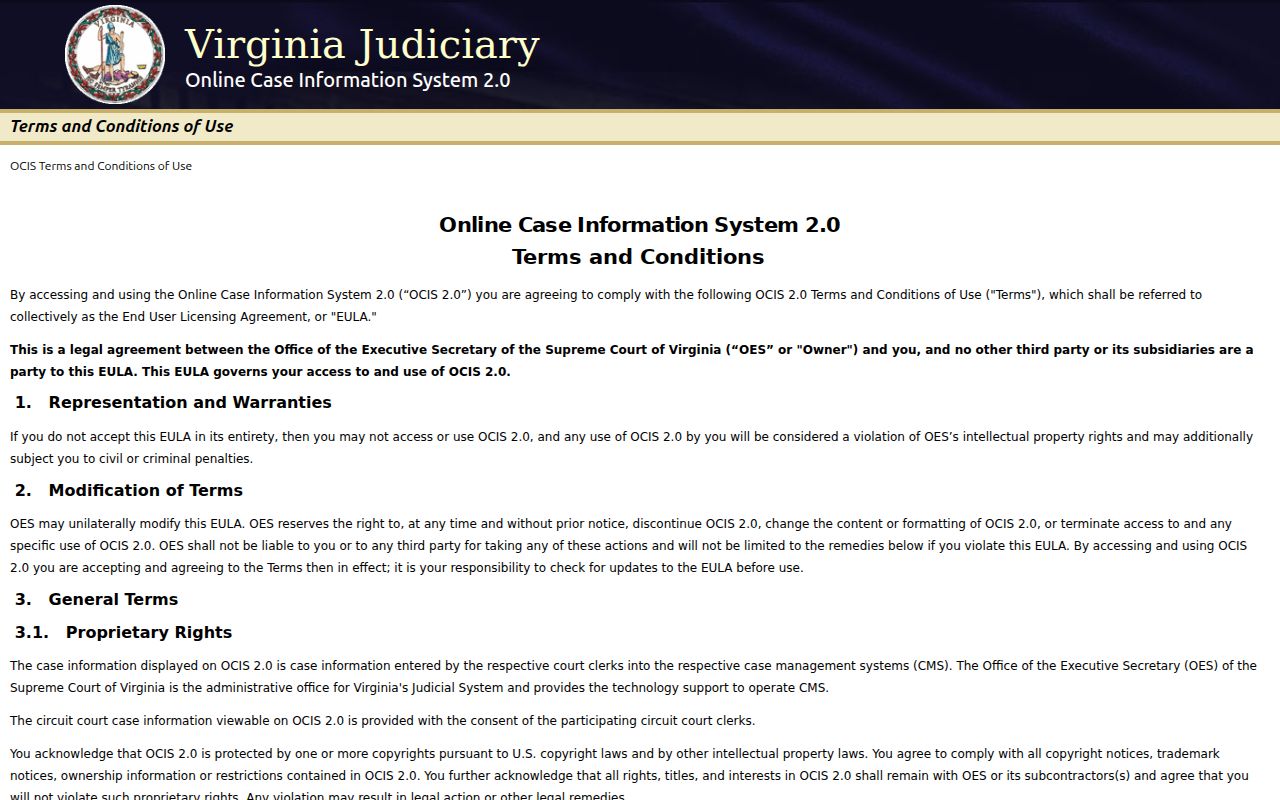
That interface is the broad starting point, but every useful result should end with the named Virginia court when documents or a final legal record are needed.
Virginia Court Cases Missing Online
A missing OCIS result does not prove that no Virginia criminal case exists. Fairfax Circuit Court is excluded, and other nonparticipating or non-OES Circuit Courts may require their own clerk systems. Older files may not be fully digitized. Public J&DR access is narrow, while confidential and sealed cases are suppressed. Search spelling, an alias, an amended charge, or movement between district and circuit court can also hide an expected match.
First, identify the likely locality and court level. Then use the Virginia Judiciary case-information hub to choose OCIS, a court-specific circuit search, or the relevant clerk. The official hub makes the coverage split visible rather than implying that one search includes all Virginia court records.
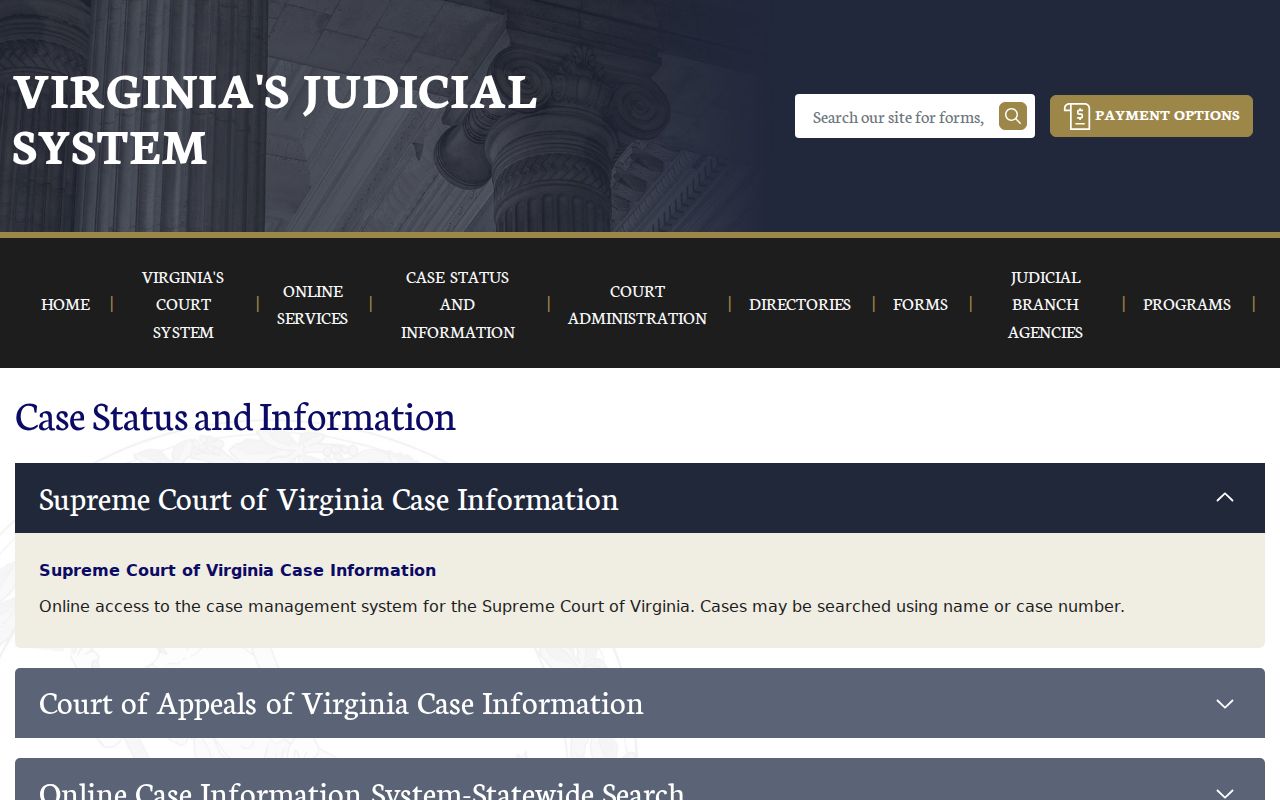
The separate choices are a practical warning: check the source court whenever statewide results look incomplete or conflict with another record.
What a Virginia Case File Contains
A Virginia criminal case file is richer than a repository rap sheet. OCIS may display structured data, while the clerk's file can hold charging documents, motions, service records, court orders, and sentencing material. Availability varies by court and by confidentiality rules.
| Virginia Case Number & Court | The local tracking key, court level, locality, and clerk contact tied to the proceeding. |
|---|---|
| Virginia Charge Details | Original and amended charge, Virginia Code section, offense date, type, class, and offense tracking number. |
| Virginia Docket Entries | Hearings, continuances, service events, motions, court actions, and appeal activity. |
| Virginia People & Counsel | Defendant name and aliases, masked birth details, counsel, judge, and case status. |
| Virginia Disposition | Plea, finding, result date, dismissal terms, or other resolution for each charge. |
| Virginia Sentence & Money | Confinement and suspended time, probation, fine, costs, restitution, and payment indicators. |
The case file records what occurred in court. The CCRE record is different. Virginia State Police assembles identity-linked, reportable arrest and disposition information from contributors, but it does not replace the pleadings and signed orders held by a clerk.
Read Virginia Case Outcomes Carefully
Docket language can describe a step rather than a result. “Certified” or “waived to grand jury” moves a felony allegation toward Circuit Court and does not establish guilt. A true bill is an indictment. No true bill means the grand jury declined the proposed charge. Nolle prosequi means the Commonwealth chose not to proceed at that time, which is not the same as an acquittal or a dismissal with prejudice.
- Virginia deferred disposition
- The court postpones a final result while conditions are met; completion may lead to dismissal under the controlling law.
- Virginia capias issued
- The court issued process to take a person into custody, often for nonappearance or an alleged violation. OCIS is not a warrant-clearance system.
- Virginia appeal de novo
- A district criminal judgment is followed by a new Circuit Court trial, so both records must be read together.
- Virginia disposition
- The outcome or current resolution of a charge, such as conviction, acquittal, dismissal, nolle prosequi, or deferral.
Note: Confirm the final signed order before relying on an abbreviated Virginia docket status or an entry that predates an appeal.
Virginia Criminal Case Stages
A typical Virginia felony begins with a Virginia complaint, warrant, or summons. After arrest, a Virginia magistrate addresses probable cause and initial bail. Virginia General District Court then holds or receives a waiver of the preliminary hearing. If the matter advances, a Virginia grand jury may return an indictment and Circuit Court opens the Virginia felony trial record. Arraignment, motions, plea negotiations, and a Virginia bench or jury trial can follow. A Virginia conviction leads to sentencing, and an appeal may move the record to the Court of Appeals.
Case flow: Charges Filed › Arraignment › Pretrial › Plea or Trial › Disposition › Sentencing
Misdemeanors usually begin and end in General District Court, unless appealed for a new Circuit Court trial. Each shift can generate another case number or docket. Matching the defendant, locality, charge, and offense tracking number helps connect the pieces without mistaking a procedural transfer for a second result.
Virginia Court Copies and Certification
Virginia OCIS is useful for finding the right file, but the Virginia clerk supplies the authoritative copy. Under Virginia Code § 17.1-208, nonconfidential Virginia Circuit Court records are open for inspection through the clerk. The statewide fee schedule identifies a standard charge of fifty cents for an ordinary copy or image, two dollars for a seal or certificate, and another fifty cents for a judge's certificate when required, unless another rule controls.
Give the clerk the case number, party name, court level, and document date when possible. Ask whether the item can be sent by mail, obtained at the counter, or accessed through a local Secure Remote Access system. Certified copies matter when the recipient needs proof that the copy matches the official Virginia court record. A screen print is not a substitute.
Virginia Court Record Access Limits
Virginia FOIA can help identify public records, but it does not override a court sealing order, juvenile confidentiality, or a criminal-history dissemination limit. Court clerks operate under court-record statutes and rules as well as public-access law. Police investigative files and the court file also have different custodians, even when they concern the same arrest.
A request should name the court, locality, case number or person, date range, and exact document sought. Ask for an estimate first when a large file is involved. Under the Virginia Freedom of Information Act procedure, covered public bodies may recover actual reasonable costs and ordinarily respond within five working days through production, denial, clarification, or a lawful extension. That process does not make a sealed Virginia case public.
County Sources for Virginia Case Records
The full Virginia criminal case file stays with the clerk where the matter was filed. County and independent-city boundaries therefore matter even when OCIS finds the docket statewide. The Circuit Court clerk is the source for felony pleadings, orders, and certifications. General District and J&DR clerks hold their respective records, subject to the access limits for each court.
Use the statewide result to capture the locality, court, and case number. Then browse the directory of all 107 project jurisdictions in Virginia to reach the county or independent-city records site. This local route is essential for nonparticipating circuits, full documents, older files, and any Virginia case whose online status needs confirmation.