
Arrest Records Across Virginia
Virginia arrest records begin with the Virginia agency that acts. A sheriff, city or town police officer, Virginia State Police trooper, campus officer, or other authorized officer creates an incident or arrest report. A local or regional jail then records intake, charges, bond, custody, and release or transfer. A magistrate handles initial process and bail work, while a court clerk creates the related docket after a charge is filed.
These records answer different questions. The booking describes a custody event. The police report may describe the alleged conduct and investigation. The court record follows prosecution and outcome. Virginia State Police receives qualifying fingerprint-backed arrest reports for the Central Criminal Records Exchange, or CCRE. That statewide file depends on what contributors send and how later court results link to the arrest. No one Virginia arrest search replaces all four sources.
Who Holds Virginia Arrest Records
The arresting agency determines where a report request goes. City and county police hold their own incident files. Sheriffs hold process records and booking records where they operate a jail. VSP holds trooper and special-agent records. Campus and special state police answer for files created under their authority. A regional jail may serve several localities, so the place of arrest and the facility holding the person can differ.
| Virginia actor | Record created | Best request route |
|---|---|---|
| Virginia police department | Incident and arrest report | Department records or FOIA officer |
| Virginia sheriff | Arrest, process, and sometimes booking | Sheriff records and jail or regional facility |
| Virginia State Police | Trooper or special-agent file | VSP FOIA channel |
| Virginia local or regional jail | Intake, bond, custody, release, and booking photo where releasable | Roster, booking line, VINE, or records request |
| Virginia court clerk | Charge, docket, disposition, and sentence | OCIS and the filing court |
| Virginia CCRE | Reported fingerprint-linked statewide history | Official own-record or SP-167 process |
From Virginia Arrest to Rap Sheet
Virginia Code § 19.2-390 is the reporting spine. It requires state and local officers with arrest power to report qualifying felony arrests, designated misdemeanors, capias and failure-to-appear arrests, and service of another jurisdiction's warrant. Fingerprints, the offense tracking number, and the agency identifier connect the reported arrest to one person and one prosecution cycle.
Data flow: Arrest › Booking › Fingerprint Submission › CCRE Entry › Court Disposition
Prosecutors, clerks, corrections officials, and other named contributors later report outcomes and custody events. A court result may fail to join the arrest when fingerprints were never taken, an offense tracking number is wrong, transmission is late, or a name variation blocks an automated match. That is why a Virginia court docket and a State Police response can disagree. The clerk's final order controls the court outcome, while the CCRE challenge route addresses the compiled state file.
Find a Recent Virginia Arrest
Recent Virginia booking information is local first. It may appear at a jail before the court has entered a case and before a fingerprint report reaches the CCRE. Search in the order the event develops.
- Identify the county or independent city and the agency that made the arrest.
- Check the sheriff or regional-jail roster, booking line, or participating Virginia Jail VINE source for current custody.
- Search OCIS after filing, then ask the correct clerk to confirm the charge, bond action, and final disposition.
- Use the official Virginia State Police process when a consent-based statewide criminal-history response is the right record.
Start with the Virginia directory of 107 project jurisdictions when the local custodian is unclear. It routes to the county and independent-city layer where bookings, jail rosters, and police files originate. The ordinary SP-167 name check is a mailed conviction product, not an instant feed of every fresh booking.
Virginia Arrest Lookup Options
Each official Virginia channel has a defined scope. SP-167 supplies an official reported Virginia conviction response using the CCRE name index and consent process. Fingerprints can support a broader subject search under current eligibility rules. OCIS provides structured court cases for covered courts. The arresting agency supplies releasable report material. A jail answers current local custody. VADOC answers state-responsible custody and supervision, not ordinary new county bookings.
The VSP SP-167 form generator collects the subject's identifying data and prepares the request. The subject signs before a notary, and a separate recipient must complete the second notarized consent section. The standard fifteen-dollar request returns Virginia conviction data. A twenty-dollar combination adds a Virginia registry search. Mail the completed form to CARE or use the allowed headquarters drop-off, but neither route produces same-day results. VSP states normal handling is about fifteen business days. When current rules allow fingerprint-based review, follow the VSP fingerprint instructions; fingerprint cards are identity evidence, not a public booking database.
The VADOC Inmate Locator source illustrates the state-custody route assigned to a later stage of the arrest record chain.
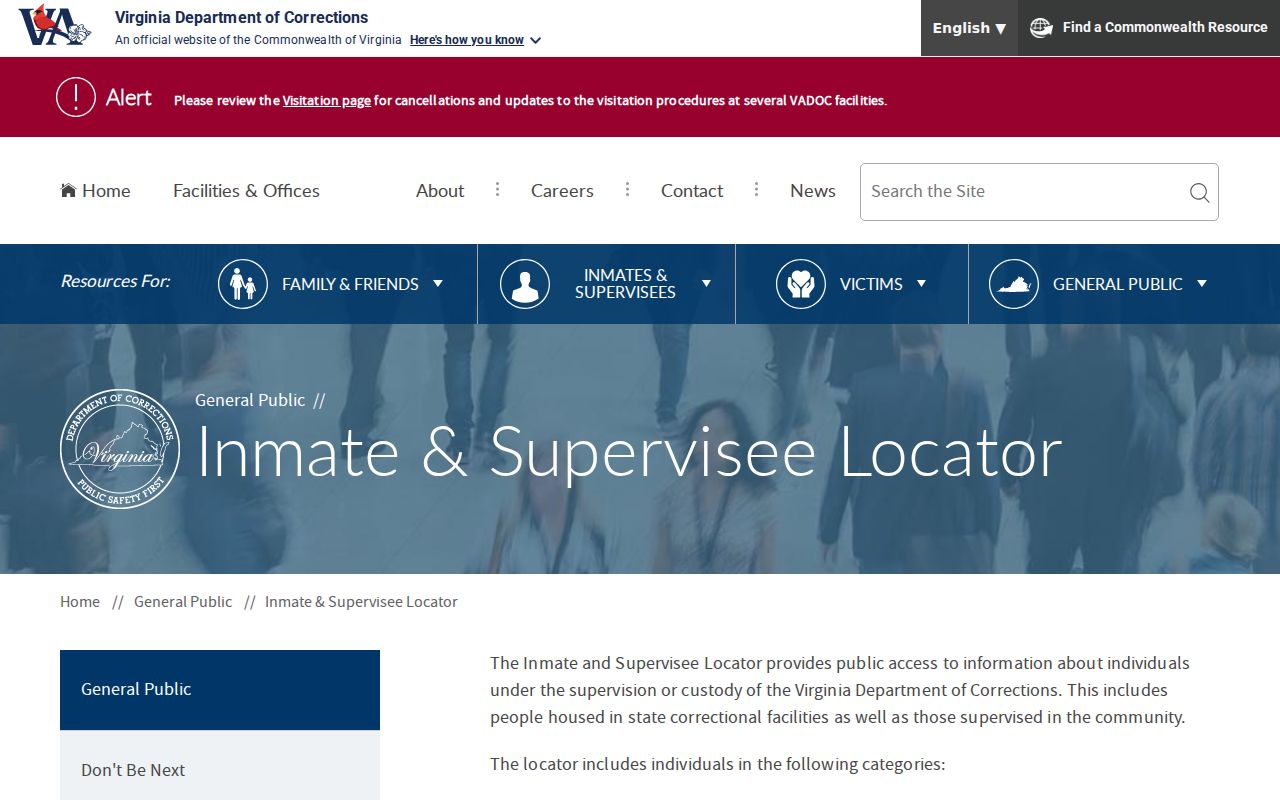
Use that Virginia search only for people within VADOC's stated coverage, including state institutions and covered supervision. Absence there does not rule out a local jail, federal custody, release, or a case without state transfer.
Fields on a Virginia Arrest Record
A Virginia booking record captures the facts recorded at intake. It does not prove that the listed charge survived review or ended in conviction. Restricted identifiers, juvenile information, victim and witness data, and investigative details may be omitted or redacted.
| Virginia Name & Identifiers | Full name, aliases, birth or age details, sex, race, and physical descriptors used to distinguish the person. |
|---|---|
| Virginia Arrest & Booking | Arrest and booking numbers, dates, times, locality, facility, and arresting agency. |
| Virginia Charge | Charge at intake, Virginia Code or Crime Code, offense date, and warrant, capias, or summons reference. |
| Virginia Tracking Keys | Fingerprint transaction and offense tracking number used to connect the arrest with later reports. |
| Virginia Custody | Facility, bond amount and type, release status, or transfer information. |
| Virginia Court Link | Locality, court, or case number when available, which should be followed for disposition. |
A booking photo may be part of the official arrest record, but Virginia's release rule has exceptions. It should be requested from the proper jail or arresting custodian. The VSP criminal image system is an authorized justice resource, not a public mugshot gallery.
Virginia VINE and Jail Rosters
A Virginia roster is a point-in-time custody view. Virginia Jail VINE adds Virginia search and notification for participating local and regional facilities. A person can register for Virginia phone, text, email, TTY, or app notices about covered custody events. Virginia participation and update timing still matter, so a critical status should be confirmed with the holding facility.
The official VINELink interface is the statewide-facing access point supplied by participating agencies.
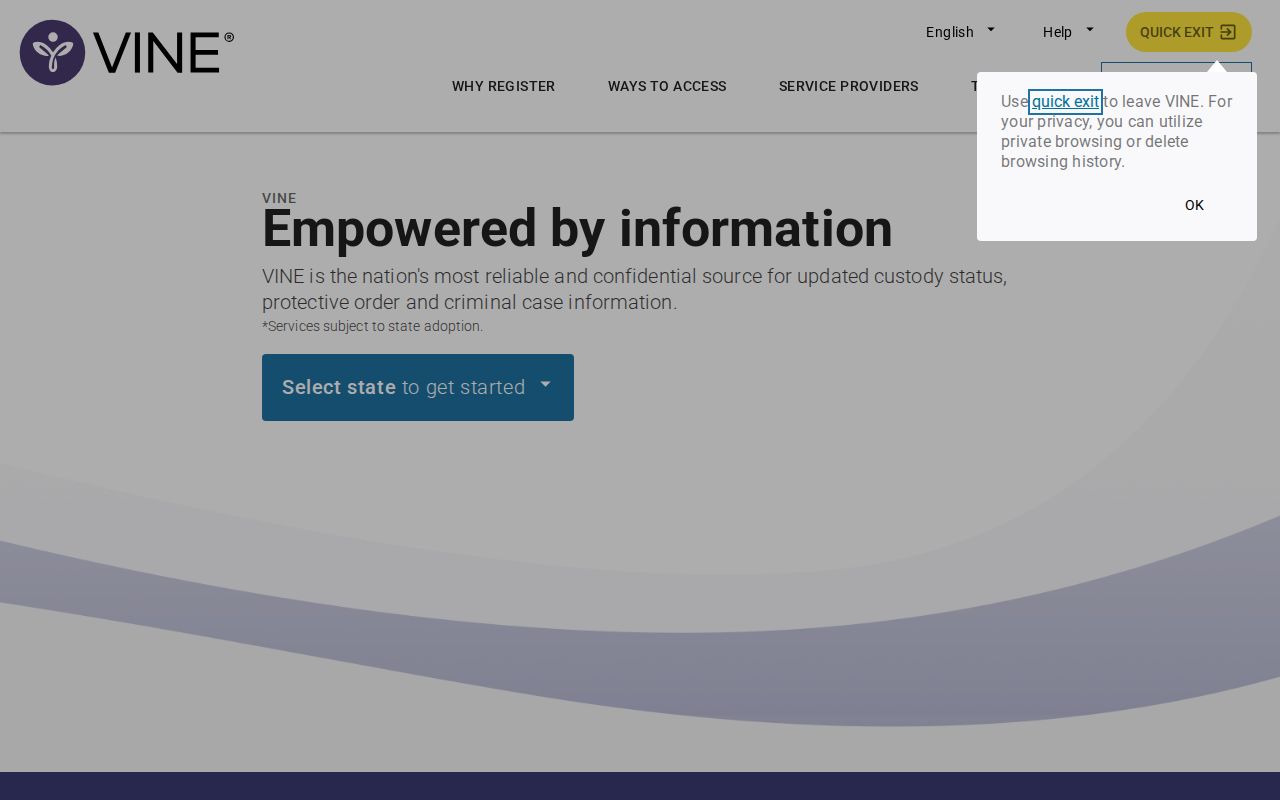
The alert function adds notice after registration, while a jail roster answers whether a person appears in custody at the time of the search. Neither source provides the court's final judgment.
Note: VADOC NAAVI is a separate post-sentence notification service, and registration in Virginia Jail VINE does not automatically transfer to it.
Virginia Arrest Counts in Context
The Virginia Crime Statistics Dashboard compiles agency-submitted UCR and NIBRS data. The published 2024 analysis lists 400,729 Group A offenses across 343,896 incidents. Age-table rows total 101,321 Group A arrests and 106,442 Group B arrests. These are counts of arrest activity, not unique people and not convictions. One arrest may clear more than one offense, and agencies can update their submissions after the initial cutoff.

The dashboard supports broad trend research and agency comparisons. It cannot identify an individual booking or show how a named Virginia criminal charge ended. For that, return to the local jail, arresting agency, and court clerk.
Request Virginia Arrest Reports
Virginia Code § 2.2-3706 requires specified basic adult arrestee identity, charge, and status information on request and generally addresses booking-photo access, subject to stated exceptions. Investigative files may be withheld or redacted to protect an active inquiry, sources, techniques, victims, witnesses, safety, or a fair trial. Juveniles sit outside the ordinary adult disclosure rule.
Send the request to the Virginia agency that created the report. State Police records go through the VSP FOIA channel, while local police and sheriffs answer for their files. Describe the date, locality, incident or case number, person, and exact item with reasonable detail. Ask for an estimate because Virginia public bodies may charge actual reasonable costs and can seek a deposit when an estimate exceeds two hundred dollars.
Mugshot access is not permission to create a private gallery. Sealed and expunged material cannot be released, and an adult felony investigation can support temporary withholding under the statute. Use official photos only for a legitimate record need and preserve the distinction between an accusation and a judgment.
Virginia Arrests and Convictions Compared
A Virginia arrest records an allegation and custody or process event. A conviction is a court judgment following a guilty plea, verdict, or other qualifying adjudication. The two can appear in connected systems, but they have different meanings and public-access rules.
| Arrest record | Conviction record | |
|---|---|---|
| Created by | Virginia arresting agency and local or regional jail | Virginia court judgment, later reported to the CCRE |
| What it proves | A Virginia arrest, process, or booking was recorded | The Virginia court entered guilt on the charge shown |
| Best follow-up | Virginia agency report, custody source, and filing court | Final Virginia clerk order and official criminal-history channel |
| Public limits | Virginia juvenile, sealed, victim, and investigative restrictions apply | Virginia dissemination and sealing rules control release |
| Record relief | Virginia nonconvictions may qualify for expungement or sealing | Only eligible convictions fit Virginia's narrower sealing routes |
Note: An arrest without a disposition is not proof of guilt, so confirm the final Virginia court result before drawing a conclusion.