
Virginia Criminal History Checks
Begin by defining the Virginia record needed. The Virginia State Police SP-167 generator starts an official statewide name check. It is a form generator, not a live results database. The ordinary Virginia response reports conviction data matched through the submitted name information. A fingerprint-supported route can address charges, dismissals, and pending events when Virginia State Police instructions allow it. Court status comes from the Virginia Judiciary, while an incident narrative comes from the Virginia law-enforcement agency that wrote it.
Recent custody takes another path. A local or regional jail holds the booking record. The Virginia Department of Corrections locator covers state-responsible custody and supervision, not every new local booking. Use the following order to avoid treating one limited result as a complete Virginia criminal history.
- Choose SP-167, a court search, a jail check, an agency request, or a custody locator based on the needed record.
- Use full identifying details and compare dates, aliases, court locations, and case or tracking numbers.
- Open the relevant county or independent-city site for the original arrest, booking, report, or clerk file.
- Confirm the final disposition with the disposing clerk before describing an arrest as a conviction.
- Use a fingerprint-based self-review or certified court copy when identity or accuracy is disputed.
Note: An SP-167 result, an OCIS docket, and a jail roster answer different questions and should be read together when the issue spans systems.
How Virginia Records Reach CCRE
A Virginia arrest creates a chain, not one document. The Virginia arresting agency prepares its report. A Virginia jail may create intake, bond, photograph, housing, and release entries. A Virginia magistrate and court clerk create judicial process and the case file. Under Virginia Code § 19.2-390, qualifying Virginia arrest information, fingerprints, offense tracking data, dispositions, and certain corrections events are reported to the Central Criminal Records Exchange.
The practical flow is: Arrest → Booking → Fingerprints and OTN → Court Case → Disposition → CCRE history. Each Virginia contributor retains its own source record. CCRE does not replace the Virginia police narrative or the clerk's pleadings and orders. Virginia clerks electronically report results that include dismissals, nolle prosequi, acquittals, convictions, sentences, reversals, and amendments. Accurate Document Control Numbers and Offense Tracking Numbers are vital because they connect later Virginia court results with the correct arrest cycle.
The Criminal History Repository in Virginia
The Virginia Department of State Police Central Criminal Records Exchange is the Commonwealth's sole central criminal-recordkeeping agency, subject to specified records kept elsewhere. It operates within the Criminal Justice Information Services Division. The Civil and Applicant Records Exchange handles much of the civil and name-check work. A focused profile of Virginia State Police criminal history checks covers each product, fee, fingerprint route, and correction process.
For a general-public SP-167 request, the subject signs before a notary. A separate recipient also completes and notarizes the recipient section. The base name check costs $15, while the history-plus-registry combination costs $20. VSP publishes a normal processing estimate of about 15 business days after receipt and states there is no expedited service. The request is mailed to CARE, so a generated form should never be described as instant access.
Why Virginia Records Can Disagree
A clean Virginia court result does not always join the state history at once. In Virginia, a missing fingerprint, an incorrect OTN or DCN, a late contributor report, or a name variation can separate a disposition from its arrest. Virginia State Police created an Orphan Disposition File in 2021 for results that could not be applied because arrest or booking information was missing or wrong. That formal Virginia process shows why an apparent mismatch is often a linkage issue, not proof that either source is fabricated.
Virginia's 2026 automatic sealing process also depends on CCRE data. Virginia State Crime Commission guidance warns that an eligible event can be missed if it was never reported or cannot be matched. When records conflict, confirm the Virginia court outcome, obtain a fingerprint-supported review of your own record, ask the Virginia contributing agency to correct its source, and then use the challenge procedure in 6VAC20-120-70. CCRE needs the source contributor's correction for a substantive event error.
Note: Absence from OCIS can reflect sealing, retention, or participation limits, so the disposing clerk remains the authoritative source for the final order.
Virginia SP-167 Request Fields
The public Virginia State Police interface builds a request that must be signed, notarized, paid, and delivered through the stated channel. It collects enough identity and routing detail to compare the subject against the Virginia CCRE master name index and return the response to the proper recipient. Optional identifiers should be protected in saved or printed copies.
| Field Group | Input | Purpose |
|---|---|---|
| Request | Form, type, and purpose | Selects SP-167, SP-230, SP-266, or a conditional route |
| Subject | Name, aliases, race, sex, date of birth | Required master-name comparison data |
| Optional identity | Middle name, maiden name, suffix, SSN | Helps distinguish similar names |
| Recipient | Name, agency, address, phone, email | Controls delivery and contact |
| Payment | Fee, method, eligible account | Completes the mailed request |
A remote online notary option currently adds $25, but it notarizes the form rather than capturing fingerprints. Virginia State Police accepts the payment methods listed in its current instructions and does not accept personal checks. The Virginia form may return a no-conviction-data label that expressly does not rule out an arrest record.
Record Systems Across Virginia
Virginia statewide systems offer broad reach but distinct coverage. The Virginia state repository compiles reported history. The Virginia Judiciary publishes structured case information from covered courts. VADOC maintains Virginia custody and supervision data. The public Virginia sex offender registry is a separate statutory notification product. Virginia county and independent-city sources remain essential for recent bookings, incident reports, local warrants, and complete court files.
| System | What It Holds | Run By |
|---|---|---|
| SP-167 criminal history check | Reported Virginia conviction history through the ordinary name route | Virginia State Police CARE and CCRE |
| Virginia Judiciary OCIS | Adult criminal and traffic case data in all district courts and select circuits | Virginia Judiciary |
| VADOC Inmate Locator | State-responsible custody and supervision records | Virginia Department of Corrections |
| Virginia Sex Offender and Crimes Against Minors Registry | Publicly disclosable registrant profiles | Virginia State Police |
Virginia Custody Systems Compared
Virginia county and regional jails usually hold people awaiting trial, serving local sentences, or awaiting transfer. Virginia's smaller localities often share a regional jail, so one county does not always mean one jail. Virginia Jail VINE can provide custody search and notices for participating local and regional facilities. It is separate from a Virginia jail's own record and from VADOC's post-sentence notification system.
The VADOC Inmate Locator is the Virginia state route for a person in corrections custody or covered supervision. Federal custody is searched through the Bureau of Prisons, not VADOC. A sound Virginia criminal record check follows the legal custodian: a Virginia local jail for a fresh booking, VADOC after state-responsible commitment, and BOP for federal custody.
Virginia Criminal Record Types
Different Virginia criminal records are created by different actors and carry different legal weight. A Virginia arrest report describes agency action and an allegation. A Virginia booking entry records custody. The Virginia court file tracks prosecution and outcome. The Virginia CCRE rap sheet assembles reportable events around an identity. None should be substituted for another.
- Arrest and booking records: held by the arresting agency and local or regional jail, with public access subject to Virginia law.
- Court case records: indexed in OCIS where covered, while the disposing clerk keeps the authoritative file and copies.
- Police and incident reports: requested from the investigating agency under the Virginia Freedom of Information Act, with investigative and privacy limits.
- Warrant and capias records: checked through the issuing court and executing agency because Virginia has no comprehensive public statewide warrant database.
- Supervision and registry records: divided among VADOC, local probation services, the Parole Board, and the Virginia registry lookup.
Virginia felony classes run from Class 1 through Class 6 under § 18.2-10. Misdemeanors run from Class 1 through Class 4 under § 18.2-11. A Class 5 or 6 felony remains a felony even when the court uses an authorized jail-or-fine alternative. OCIS can show original and amended charge classes, so the final amended charge and disposition must be checked.
Virginia Warrant Search Limits
Virginia does not publish a complete statewide warrant-name search. VCIN and NCIC are law-enforcement systems. A warrant or capias may appear in the process or status entries of an existing court case, but sealed, active, or tactical information can be withheld. VADOC's Most Wanted page is only a selected list of corrections fugitives and is not a statewide warrant index.
The useful check chain is OCIS for the underlying case, the issuing clerk for current court process, and the appropriate sheriff or police warrant unit for releasable status. A person who may have active process should consider counsel before arranging a safe resolution. A portal result cannot promise that approaching an office will be arrest-free.
Virginia Record Access Laws
The Virginia Freedom of Information Act provides a request process for public records, but it is not a universal rap-sheet law. The agency that holds the record answers the request and may apply specific exemptions. CCRE history has separate dissemination limits. Courts, law enforcement, corrections, and the registry also follow their own statutes.
Key Virginia laws:
Code § 2.2-3704 sets the public-record request, response, and reasonable-cost process.
Code §§ 2.2-3706 and 2.2-3706.1 govern law-enforcement information, basic incident facts, and exemptions.
Code § 19.2-389 limits who may receive Virginia criminal-history record information.
Code § 9.1-132 gives a person a route to inspect and challenge their own record.
Virginia agencies ordinarily respond to a FOIA request within five working days by producing records, denying with a legal basis, seeking clarification, or using a lawful extension. Actual reasonable costs may apply. Juvenile material, sealed or expunged records, victim and witness information, supervision files, and active investigative material may remain restricted.
Virginia Sealing Since July 2026
Virginia's automatic and petition sealing framework took effect July 1, 2026. It is distinct from traditional expungement under § 19.2-392.2. Automatic routes cover listed misdemeanor convictions, specified marijuana records, and qualifying non-convictions under detailed date and record-history rules. Petition routes cover a broader but limited group of offenses, with waiting periods, exclusions, restitution rules, and a lifetime cap for the general route.
The Virginia State Crime Commission sealing hub records the rollout and current official materials.
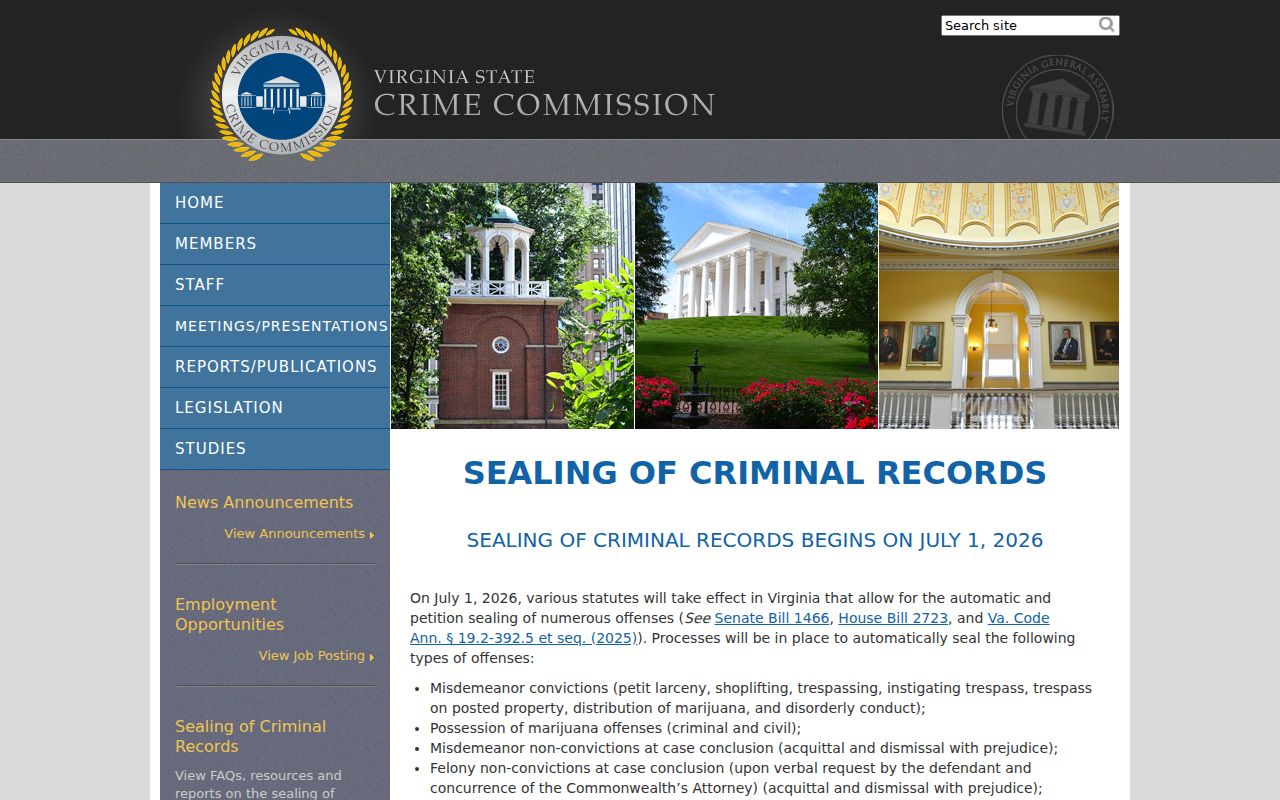
The captured interface points readers to official implementation resources rather than an unofficial eligibility promise. A sealed record is generally removed from ordinary public access but retained for specified governmental uses. Expungement is the separate remedy mainly associated with qualifying non-convictions and follows a more restrictive handling process.
The official Virginia sealing FAQ explains why missing fingerprints or a transmission error can cause an eligible record to miss automatic treatment.
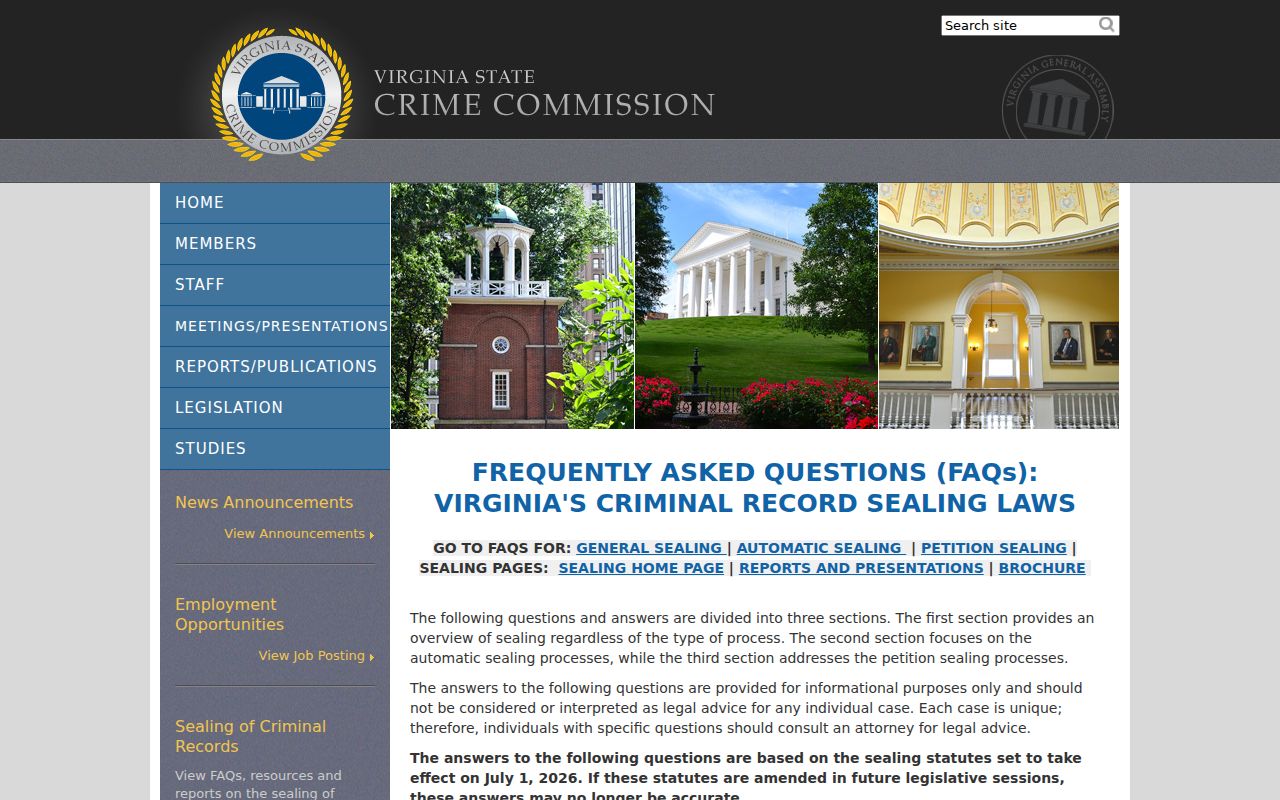
Verification should combine OCIS, a personal VSP criminal history, and the disposing clerk. Filing for expungement or sealing is tied to the proper circuit court, so the county or independent city still controls the local route.
Virginia Criminal Record Fees
Statewide published fees vary by the product and identity method. Local clerks, police agencies, sheriffs, and vendors may apply other lawful charges. Confirm a current total before mailing a payment or scheduling fingerprint capture.
| Virginia Record Service | Published Fee |
|---|---|
| SP-167 or SP-230 Virginia history | $15 |
| History plus Virginia registry search | $20 |
| Remote online notary | Extra $25 |
| Authorized Virginia and FBI file search | $27, capture separate |
| VSP fingerprint cards | $10 first, $5 each additional |
| Circuit clerk ordinary copy or image | $0.50 per page |
| CCRE misidentification challenge | No fee |
Note: FOIA charges reflect actual reasonable production cost, and a Virginia agency may seek a deposit when its estimate exceeds $200.
Virginia Probation and Parole Records
Virginia supervision is split. VADOC Community Corrections supervises state-responsible felony probationers, parolees, and post-release cases through districts. Local community-based probation services handle many local-responsible misdemeanor matters. A sentencing order can show that supervision was imposed, while the day-to-day officer file and current conditions may be withheld under the law-enforcement records exemptions.
The Virginia Parole Board publishes decisions and policies for the limited groups still eligible for parole.

The Board makes parole decisions, while VADOC carries out supervision. For a current Virginia record, use the VADOC locator, the sentencing court, a relevant Board decision, and the proper state or local supervision office rather than assuming every probation case belongs to VADOC.
Federal Criminal Records in Virginia
Federal cases do not appear in Virginia OCIS. The Commonwealth is divided between the Eastern and Western Districts of Virginia. Federal docket entries and documents are searched through PACER, while the federal clerk supplies court-specific help. The FBI Identity History Summary is a fingerprint-based self-review product for the subject, not a name-only Virginia search.
The official PACER interface is the national route for federal case records.
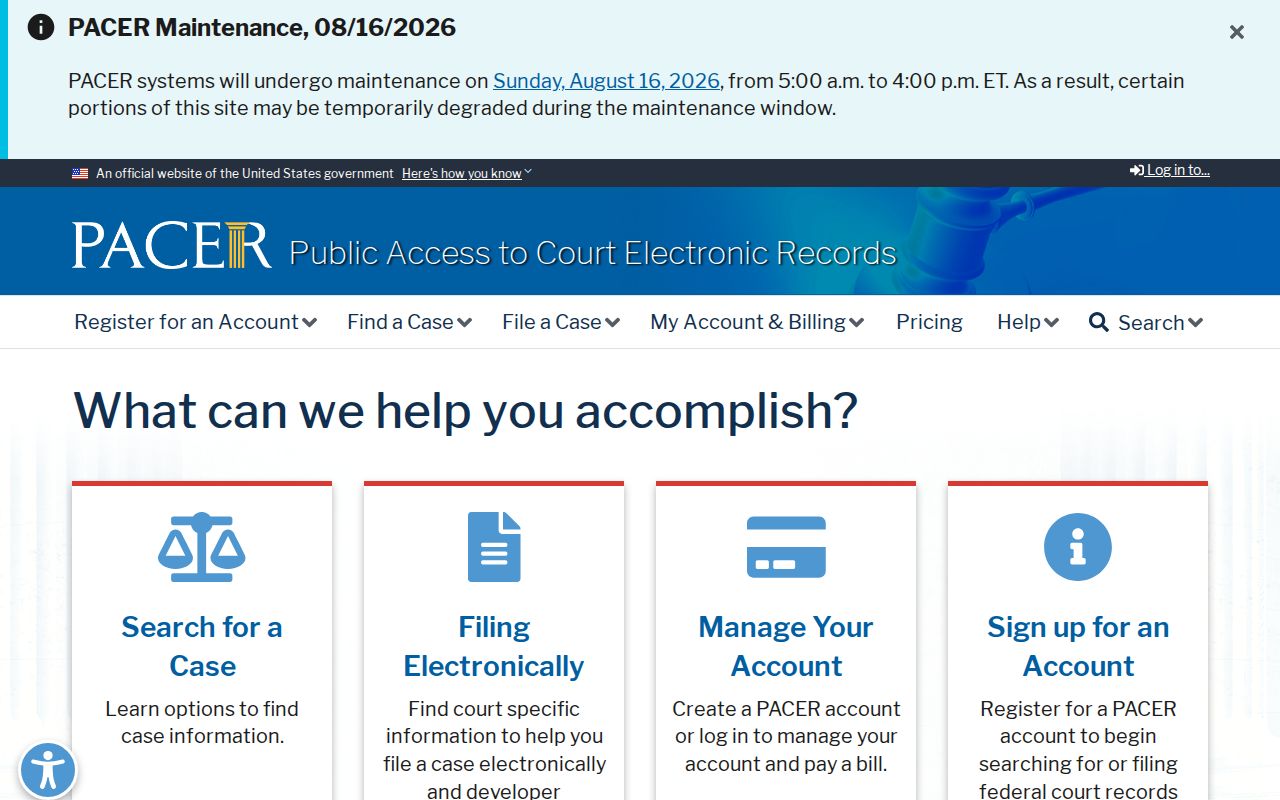
As of August 11, 2026, PACER charges $0.10 per page, most case-specific documents are capped at $3, and quarterly fees of $30 or less are waived. A temporary change announced for January 1, 2027 raises the page fee and waiver threshold. Federal custody uses the BOP locator, while a Virginia arrest or local jail record still routes to the county or independent city.
Virginia Criminal Records by County
Arrests, bookings, incident reports, and original court files are created within Virginia's counties and independent cities. The project includes all 95 counties plus 12 independent-city sites. City records belong to that independent city rather than the surrounding county. The largest included jurisdictions offer useful starting points for Northern Virginia, Hampton Roads, and the Richmond region.
Fairfax County
Fairfax · Largest included locality and a separate Circuit search route
Prince William County
Manassas · Major Northern Virginia court and sheriff jurisdiction
City of Virginia Beach
Virginia Beach · Independent-city police, sheriff, jail, and courts
Loudoun County
Leesburg · Fast-growing Northern Virginia records system
Chesterfield County
Chesterfield Court House · Major Richmond-region jurisdiction
Henrico County
Laurel · Separate county record system around Richmond
City of Chesapeake
Chesapeake · Independent-city police, sheriff, and courts
Arlington County
Arlington · Compact Northern Virginia court and agency network
Browse the full directory of all 107 Virginia project jurisdictions to reach the criminal records site for the correct county or independent city.